What Are Peptides and How Do Peptides Work?
“Remember: Peptides are precision tools. They are not shortcuts.”
Dr. Mindy Pelz
How to Decide Which Peptides to Take?
Peptides are the new shiny object in Women’s Wellness trends.
Some people call them life changing. Others feel absolutely nothing.
Here’s what certain peptides promise:
Weight loss
“Reduces the food noise”
Clear brain fog
Improve mood and anxiety
Gut repair
Longevity
Faster recovery
But, before anyone sells you a protocol, let’s slow down. Here is what I’ve learned about what peptides are, why they matter, and how to decide whether they belong in your health journey.
Table of Contents
1. What are peptides and how do peptides work?
a. Why peptides matter more as we age
b. Can you get peptides from food?
2. 3 Ways Peptides are Being Studied in Research.
a. Brain health & nervous system
b. Weight loss & metabolic health
3. A list of peptides and why they are currently being researched.
4. How do I decide which ones to take?
5. How do you take therapeutic peptides?
1. What Are Peptides and How Do Peptides Work?
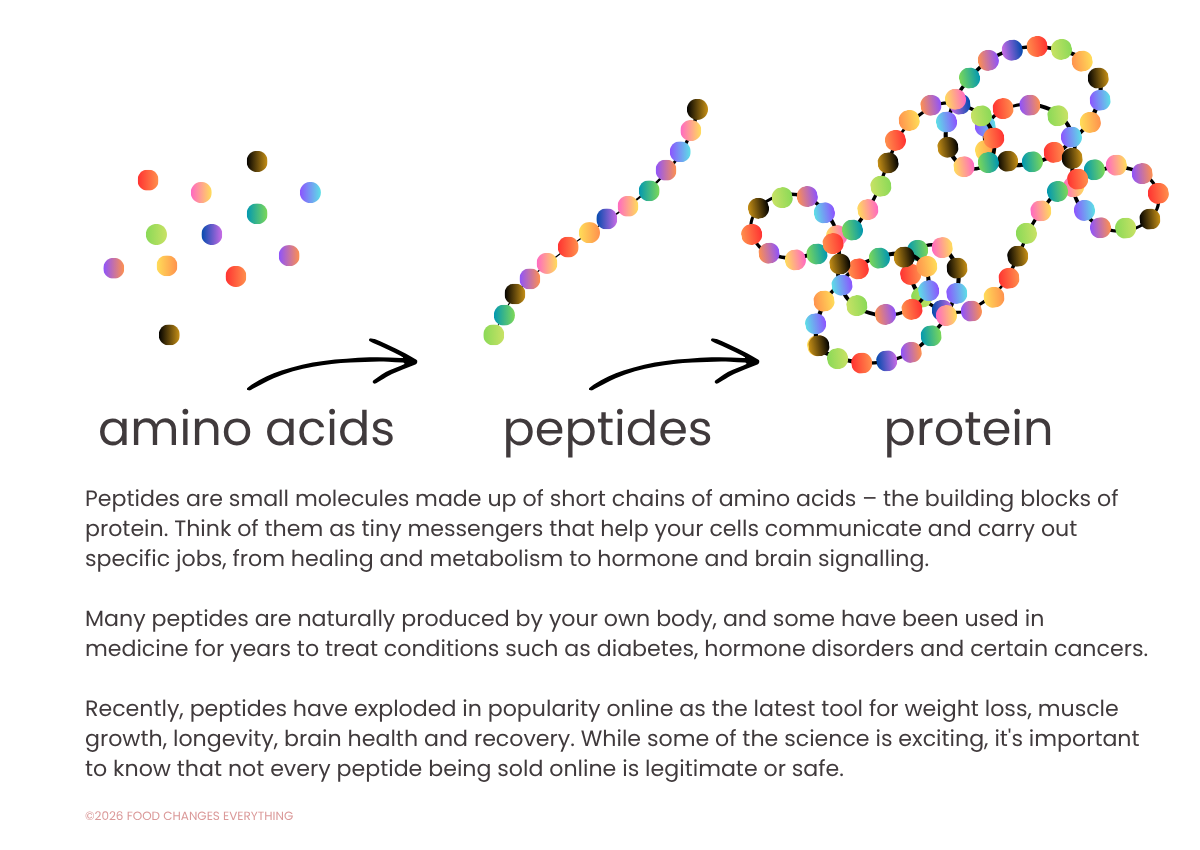
In plain English: Peptides are signaling molecules. They tell your cells what to do.
In body chemistry language: peptides are short chains of amino acids.
Remember amino acids? Amino acids are the building blocks of protein.
While proteins are long chains, peptides are short chains of amino acids strung together.
· Some hormones are peptides.
· Some growth factors are peptides.
· Insulin, that regulates blood sugar is a peptide.
· GLP-1’s go by the brand names Wegovy, Mounjaro and Ozempic.
These popular weight loss drugs are peptides.
· Oxytocin, the love hormone also falls in this category.
Important: Many peptides are substances that your body already produces.
The question is, is your body still producing peptides or has this process slowed down?
a. Why Peptides Matter More as We Age
Declining hormones = decline in communication between our cells.
Here’s how aging impacts our cell signaling:
Chronic stress → elevated cortisol → disrupted signaling
Insulin resistance → breakdown in metabolic communication
Mitochondrial dysfunction → less cellular energy
Poor protein digestion means amino acids are less available
Gut microbiome disruption
Hormonal shifts (especially declining estrogen)
Peptides are being explored as a way to restore that communication.
But here’s where it gets interesting.
b. Can You Get Peptides from Food?
Yes… BUT also…
When you eat protein, your body breaks it down into amino acids and small peptides. Certain foods contain bioactive peptides:
Bone broth and collagen-rich foods
Dairy and eggs
Fermented foods
Plant proteins
Protein digestion in general
Food provides the raw materials.
BUT if your digestion is weak, AND your microbiome disrupted, AND your protein intake low, you may not create these peptides yourself in your own body.
2. Three Ways Peptides are Being Studied in Research for Women.
You may be thinking, “Why should I take peptides?”
You need to know that right now, there are NO EXPERTS in this field. Peptide use is truly breaking new ground. So, let’s simplify peptides into three main benefits aimed at Women’s Health concerns and my current focus as a health coach.
a. Brain Health & Nervous System
Peptides in this category are explored for:
Perimenopausal brain fog
Anxiety and stress resilience
Cognitive decline
Neuroplasticity support
Mechanisms often discussed:
Increasing BDNF (brain-derived neurotrophic factor)
Regulating cortisol
Supporting sleep and growth hormone pathways
This is what you need to know:
Before you jump in and start taking peptides, did you know you can support BDNF naturally without supplementation?
BDNF is like fertilizer for your brain. It helps support neuroplasticity, your brain’s ability to grow, adapt, learn, repair and create new connections. Healthy BDNF levels are linked to better memory, mood, focus and stress resilience.
You naturally support BDNF when you:
Sleep well
Lift weights
Practice intermittent fasting
Manage stress
Move your body regularly
Eat enough protein and nutrient-dense foods
These habits already influence BDNF, growth hormone and your body’s natural repair systems. You don’t need to add peptide if you are doing these things
Examples of peptides for brain/stress/sleep: Selank, Semax, DSIP, Oxytocin, CJC-1295 + Ipamorelin.
b. Weight Loss & Metabolic Health
So, you may have hear of GLP-1 drugs which are actually peptides (short chain amino acids.) We know them by their brand names Wegovy, Ozempic or Mounjaro. Or maybe you know them by their active ingredient semaglutide and tirzepatide.
They are known to:
Reduce appetite
Slow gastric emptying
Improve insulin sensitivity
Reduce “food noise”
They are effective and also come with some risks:
Muscle loss risk
Gut motility issues
Dependency
Rebound weight gain (if healthy habits aren’t built.)
Other metabolic peptides are being explored for:
Visceral fat reduction (fat around the organs and belly.)
Growth hormone support
Mitochondrial function
This is what you need to know:
If you come off a metabolic peptide without rebuilding muscle, protein intake, stress regulation, and insulin sensitivity… your appetite will return.
Peptides work while you take them. When you stop, you need to instill good habits to ensure you maintain your physiology.
Examples of Peptides for Weight/metabolism: Semaglutide, Tirzepatide, Retatrutide, AOD-9604, Tesamorelin, MOTS-c.
c. Gut Health & Tissue Repair
This is where peptides get especially interesting. Certain peptides are studied for:
Leaky gut
IBD
Post-antibiotic damage
Microbiome repair
Tissue healing
They’re described as:
Reducing inflammation
Improving gut lining integrity
Supporting repair
This is what you need to know:
I think a short, structured experiment can make sense you’re your basic health foundations are in place.
Examples of peptides for gut/repair: BPC-157, KPV, Thymosin Beta-4/TB-500, LL-37.
3. A list of peptides and why they are currently being researched.
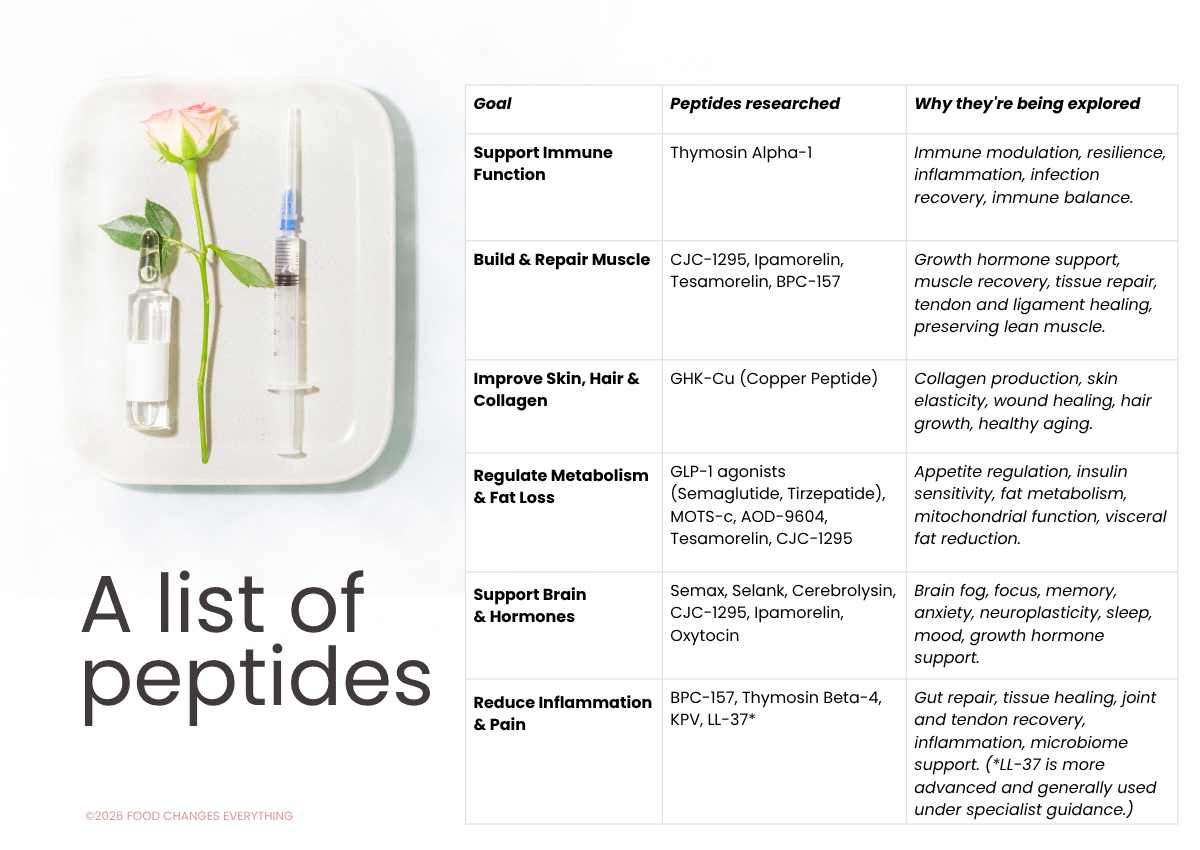
PLEASE NOTE: some peptides are approved medicines, some are supplements/skincare ingredients, and some are unapproved “biohacker” peptides with limited human safety data.
Be careful with injections and anything sold “for research use only.” The FDA and Swissmedic have warned about unapproved peptide products sold online.
4. How do I decide which ones to take?
The Decision Framework (Before You Try Anything)
This is the most important part of this blog. Before peptides, ask:
a. What system in my body is actually dysregulated?
Metabolic?
Hormonal?
Immune?
Neurological?
What’s upstream?
Insulin?
Cortisol?
Microbiome?
Trauma
Chronic stress?
b. Are my foundations solid? Peptides without foundations are expensive experiments.
Ask yourself, and be honest:
Am I sleeping well?
Am I eating enough protein (and diversifying it)?
Am I strength training?
Am I eating fiber and fermented foods?
Is my stress constantly high?
c. What’s my peptides “exit” plan?
If I stop taking the peptides:
What habits do I need to instill in order to maintain my results?
What system improvements remain?
What areas in my body am I building underneath the peptide in order to support health long term?
5. How do you take therapeutic peptides?
There are four main ways you can take peptides: injection, oral, nasal, and topical.
1. Injectable (most common in medical settings)
Subcutaneous injections
Used for gut repair peptides, growth hormone-supporting peptides, GLP-1 agonists, and more
Strongest systemic impact
2. Oral
Many peptides are degraded in the gut
Newer technologies are improving stability
Often used for collagen peptides or certain gut-focused compounds
3. Nasal
Can influence brain signaling more directly
Often discussed for mood or cognitive peptides
4. Topical
Mostly local effects (commonly used in skincare)
The more powerful the delivery system, the more important professional guidance becomes.
Please DO NOT ORDER random compounds online and “see what happens.”
6. What Happens When You Stop Peptides?
It depends.
GLP-1 agonists: appetite typically returns. Weight regain is likely if habits weren’t built.
Growth hormone-supporting peptides: benefits fade gradually as levels return to baseline.
Repair peptides (like those used for gut healing): tissue repair may remain.
Brain peptides: effects may taper; nervous system state still matters.
This is why peptides should be seen as bridges, not permanent scaffolding.
7. Bottom Line: My Recommendation
This is not medical advice. Please consult your doctor or health care professional when it comes to new protocols, medicines, supplements and peptides. Always discuss with a qualified clinician if you’re pregnant, breastfeeding, managing complex medical conditions, or taking medications.
MY OPINION: Peptides are POWERFUL and exciting.
They may be part of the future of medicine. And that is exciting. They also have not yet been tested long-term.
My wish for you is to come back to your own body.
To ask better questions.
To track your own data.
To build foundational health.
To notice what works.
It’s time to create a strong relationship with your own physiology. And when your relationship with your body is solid, any tool — peptide or not — becomes a conscious choice.
If you’re curious, for example, about trying gut repair peptide BPC-157, please check first that the peptide product is legal in your country. In Switzerland, most peptides are illegal.
Then consider this framework when you try any new product or supplement.
ALWAYS: Discuss with a qualified clinician before starting, especially if you’re pregnant/breastfeeding, managing complex GI disease, taking medications, or have a history that requires extra caution.
Trial window: 30 days
Keep lifestyle basics steady: protein, fiber, hydration, sleep
Track 5 things daily:
bloating (0–10)
bowel movements (frequency + ease)
reflux/upper GI discomfort
energy (0–10)
mood/irritability (0–10)
Evaluate at 2 weeks and again at 4 weeks to see what has changed. Then evolve. More isn’t always better.
A few red flags to watch for!
If you're curious about peptides, be cautious of products that:
Promise dramatic or "miracle" results.
Don't clearly identify the manufacturer or where they're made.
Are sold through social media, messaging apps or unofficial websites.
Use phrases like "research chemical," "not for human use," "laboratory chemical," "anti-ageing," "fat burner," "muscle growth," "rapid recovery," "tanning," or "libido enhancer."
These are all signs to slow down, ask more questions and do your homework.
PS Knowing that these are made out of protein pieces or amino acids, why not just eat more protein??
Sending you healthy vibes and good wishes,
Vanessa
